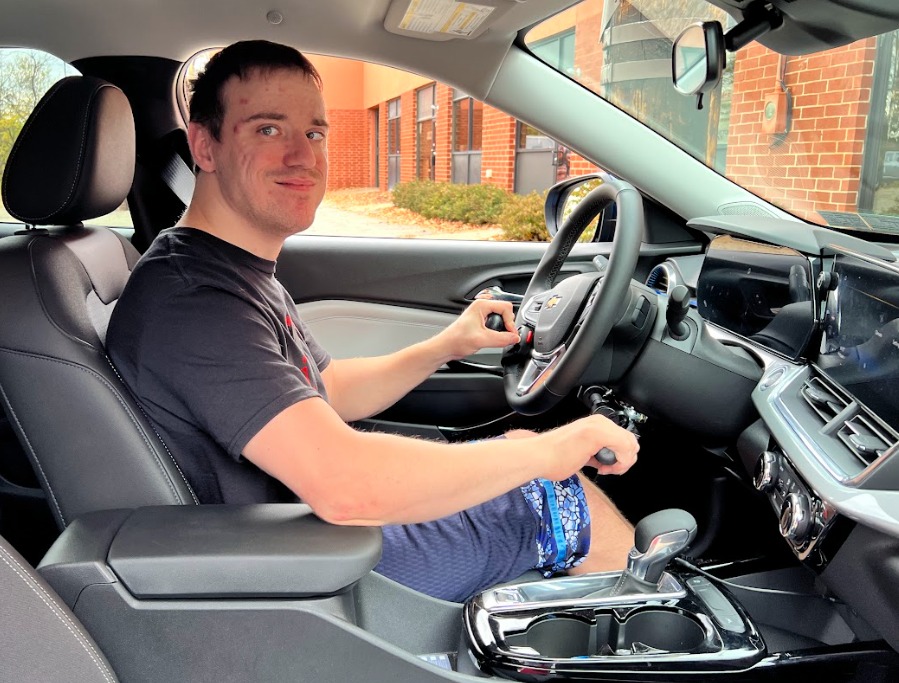
There are many reasons a driver might need adaptive equipment to drive including but not limited to:
- Stroke
- Spinal Cord Injury
- Traumatic Brain Injury
- Multiple Sclerosis
- Muscular Dystrophy
- Amputations
- Peripheral Neuropathy
- Physical Disability
The driver evaluation determines what equipment is necessary. Following a successful evaluation, driver training can begin as soon as scheduling permits. The number of lessons varies with each person. The main objective is for the student to be proficient in the use of the equipment and feel comfortable. An estimate of the number of lessons will be determined during the evaluation.
Types of Adaptive Equipment
There are multiple different types of adaptive equipment.
- Hand Controls – for gas and brake – can be on the right or left side
- Push/rock
- Push/pull
- Push/right-angle
- Steering Devices – some steering orthotics have capabilities for secondary functions (i.e. turn signals, horn, wipers, etc.)
- Spinner knob
- Tri-pin
- Palm Cuff
- Single-post
- Left-Foot Gas Pedal
- Pedal Extension(s)
- Reduced-Effort Steering
- Special Mirrors
Adaptive Van
A person utilizing a powered wheelchair or scooter for mobility may need a specially modified van along with adaptive driving equipment. If a person is using a manual wheelchair but cannot load/unload it from a car, a van may be the vehicle of choice. The evaluation determines what equipment is necessary as well as what type of vehicle is appropriate.
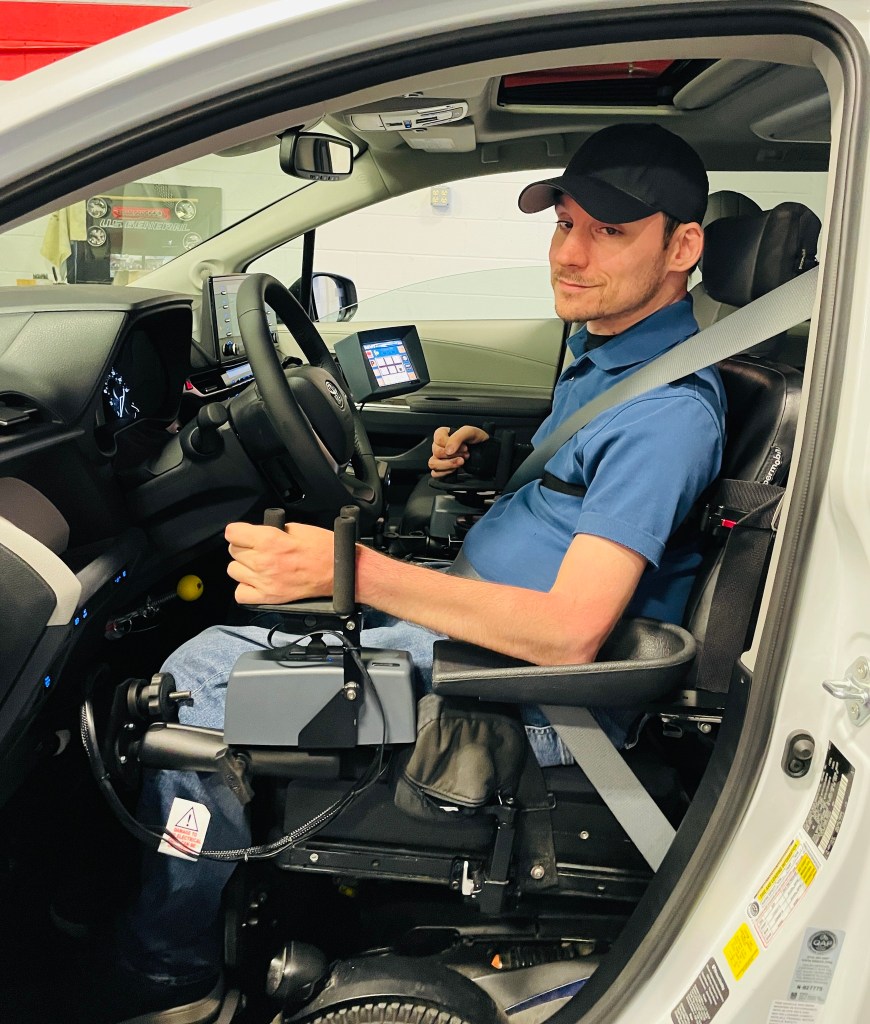
Brant’s Driving School offers high-tech driving solutions. Some disabilities that may require this type of equipment include:
- Muscular Dystrophy
- High Level Spinal Cord Injury
- Multiple Sclerosis
- Osteogenesis Imperfecta
- Arthrogryposis
- TARS Syndrome
High-Tech Driving Equipment
- Electronic gas and brake – can be placed on either side
- Micro-wheel for steering – can be placed on either side and usually on a horizontal plane
- Joystick Driving System – very similar to a powered wheelchair
- AEVIT 2.0 touchscreen for starting, shifting and other secondary functions
It is important to remember that even when a vehicle is equipped with any adaptive equipment, anyone else can still drive it. The gas and brake pedal remain unchanged. The adaptive equipment can be turned off and the OEM steering wheel can be used.
Vehicle Modification
After the process is completed, a Certified Driver Rehabilitation Specialist from Brant’s Driving School writes a detailed equipment prescription. This is taken to a NMEDA certified vendor to have the equipment installed. A quality vendor will require a prescription by a CDRS before installing equipment.
*All adaptive training is completed in a Brant’s Driving School vehicle for insurance and safety reasons, and for the purpose that our vehicles are adaptable to all the adaptive equipment one might be needing. Exceptions for previous adaptive drivers will be made on a case by case basis after review by a supervisor.
Think you may need adaptive equipment to drive?
Please call our office at 877-395-7011 to get more information and to get signed up!
When you call, please have the client’s Doctor’s Information (Address, Phone, and Fax Number) ready. This information is needed for our Medical Approval Form, which must be completed by the doctor before scheduling.
Cancellation FEe
Please note that once you have booked an appointment with us it means that we have reserved time in our schedule exclusively for you. If you cancel your appointment less than 24 hours before it is scheduled to take place, you will be subject to a cancellation fee and rebooking charge. To avoid a cancellation fee, please provide cancellation notice at least 24 hours prior to your appointment.
 Brant's Driving School